Business Central vs QuickBooks vs Sage: An Honest Comparison for Growing African Businesses

There is a predictable moment in the life of a growing business. The accounting package that served you faithfully at ten staff starts to creak at eighty. Reports take a week. Stock and finance disagree. Three people maintain spreadsheets that should not exist. The question is no longer "which bookkeeping app?" but "which platform do we grow on?"
We are a Microsoft partner, so we have a point of view — but we also migrate clients off systems every month and know exactly where each one shines and strains. Here is the candid version.
The Short Answer
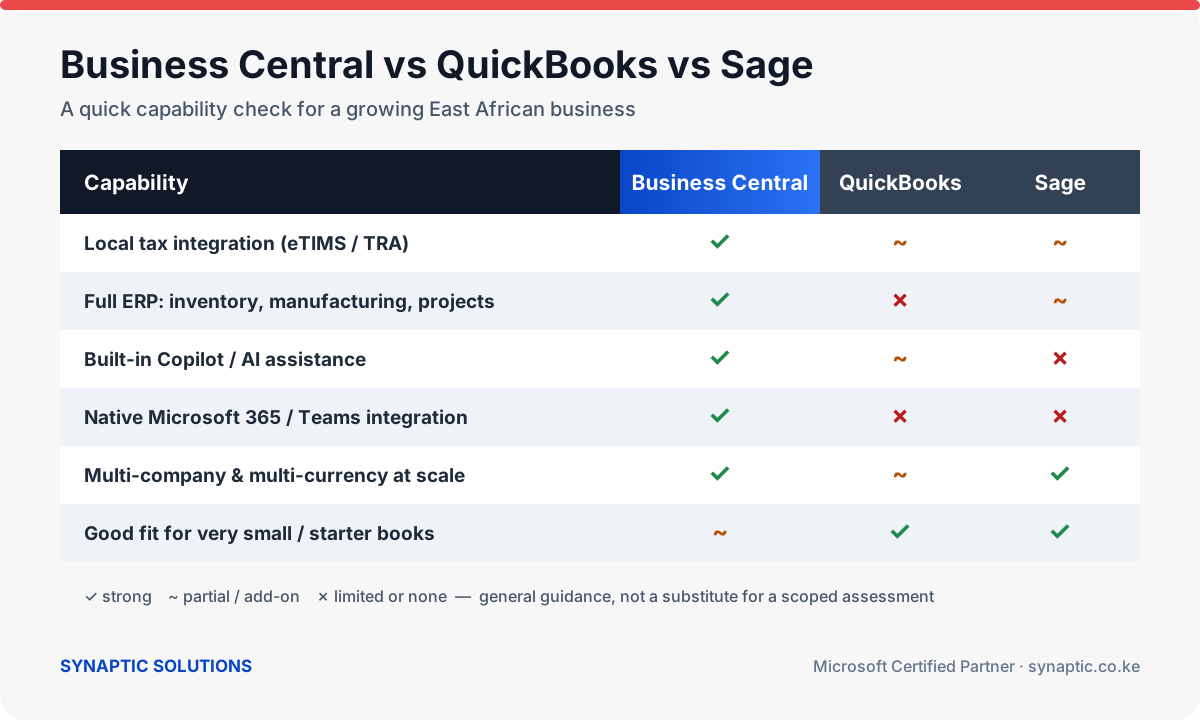
If you are a micro-business that mostly needs clean books and tax returns, QuickBooks or Sage will serve you well and cost less to start. If you are scaling — multiple entities, inventory, projects, manufacturing, or a serious compliance burden — Dynamics 365 Business Central is built for where you are going, not just where you are.
Where QuickBooks Wins
QuickBooks is fast to set up, familiar to most accountants, and inexpensive for small teams. For a single-entity services business with simple inventory needs, it is hard to beat on time-to-value. Its limits appear with scale: deeper inventory and manufacturing, multi-company consolidation, and heavy local-compliance automation are where it strains.
Where Sage Wins
Sage has a long heritage and a strong presence in African markets, with solid multi-currency support and payroll options in several countries. Depending on the product in the Sage range, you can go a long way. The trade-off is often a more fragmented product family and less of the seamless, single-platform AI and Microsoft 365 integration that Business Central offers out of the box.
Where Business Central Wins
- It is a true ERP, not just accounting — finance, inventory, manufacturing, projects, sales, and service in one system, so your data stops disagreeing with itself.
- Local tax compliance is embedded — KRA eTIMS, TRA, and other authority integrations run inside the transaction flow. See our 2026 Business Central deep dive.
- Copilot is built in — AI assistance for reconciliation, invoice capture, and analysis, included rather than bolted on.
- It lives inside Microsoft 365 — Outlook, Excel, and Teams integration your team already knows, which drives adoption.
- It scales — multi-company, multi-currency, multi-country from the same platform.
The Real Decision Isn't the Software
After dozens of implementations, we will say the quiet part out loud: the software matters less than the partner and the data. A well-implemented QuickBooks beats a badly implemented ERP every time. The right question is not only "which product?" but "which platform can we grow on for the next decade, and who will implement it properly?" Our ERP selection framework walks through exactly how to decide.
Weighing a move up from starter accounting software? Book a no-obligation assessment and we will give you an honest recommendation — even when that is not us.