The 2026 Cybersecurity Playbook for East African Businesses: Ransomware, BEC and Zero Trust

Here is an uncomfortable truth we see on nearly every engagement: the breach that hurts you most will probably not be exotic. It will be a stolen password, a cleverly timed email, or a backup nobody tested. The attackers targeting East African businesses are not running Hollywood zero-days — they are walking through doors we left open.
That is actually good news, because it means the fixes are known. This playbook sets out, in plain language, what your organisation should prioritise in 2026.
The Threats That Actually Hit African Businesses
- Business Email Compromise (BEC) — the single most financially damaging threat in the region. An attacker compromises or spoofs an executive or supplier mailbox and redirects a payment. Losses routinely run into tens of millions of shillings per incident.
- Ransomware — attackers encrypt your systems and increasingly steal data first, threatening to leak it. Double-extortion is now standard.
- Credential theft and MFA fatigue — phishing kits now bypass basic defences, and stolen passwords are the entry point for most breaches.
- Mobile money and payment fraud — social engineering of staff and customers around M-Pesa, Tigo Pesa, and Airtel Money flows.
Seven Priorities for 2026
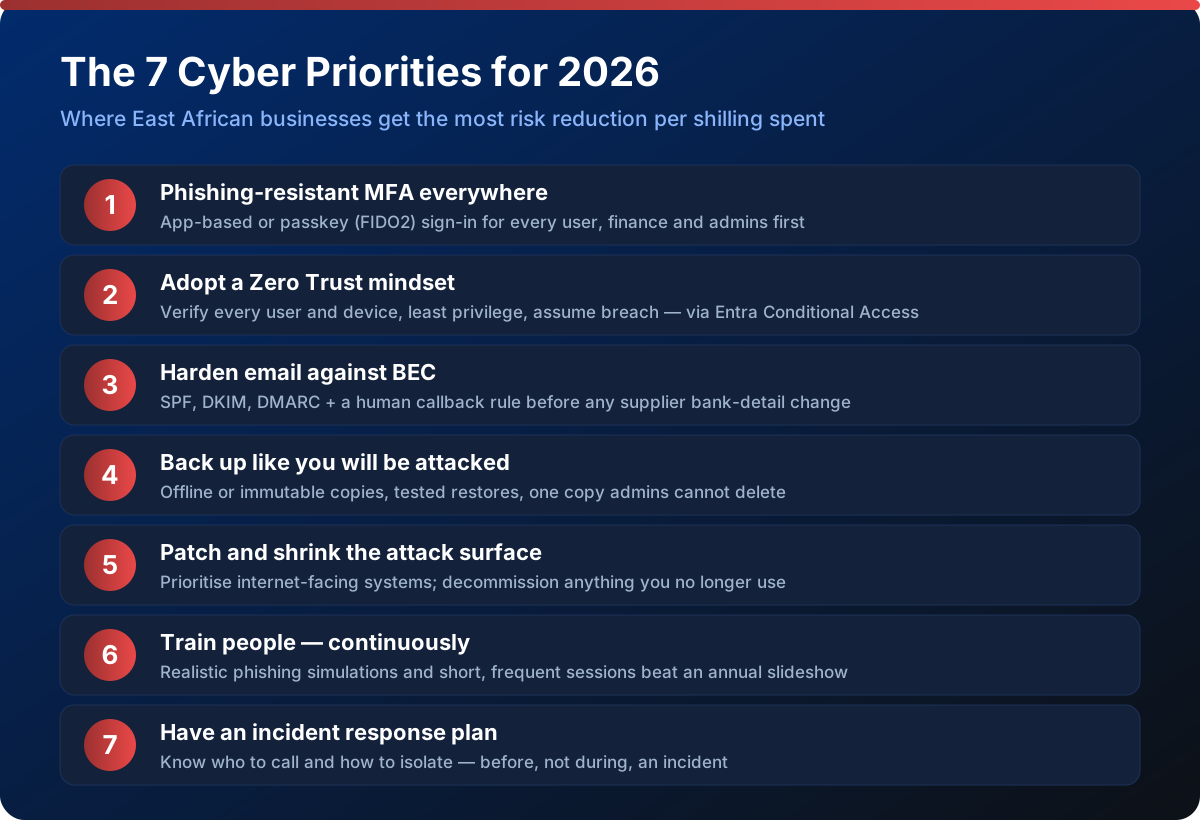
1. Enforce Phishing-Resistant MFA Everywhere
Multi-factor authentication is the highest-return control you can deploy. Move beyond SMS codes toward app-based or passkey (FIDO2) authentication, and enforce it for every user — especially finance staff and administrators.
2. Adopt a Zero Trust Mindset
Stop trusting the network perimeter. Verify every user and device explicitly, grant least-privilege access, and assume breach. Microsoft Entra Conditional Access makes this practical for organisations already on Microsoft 365.
3. Harden Email Against BEC
Configure SPF, DKIM, and DMARC on your domains, enable advanced anti-phishing in Microsoft Defender for Office 365, and — critically — put a human callback process in place for any change to supplier bank details.
4. Back Up Like You Will Be Attacked
Maintain offline or immutable backups, test restoration regularly, and keep at least one copy your administrators cannot delete. A tested backup is what turns a ransomware catastrophe into an inconvenience.
5. Patch and Reduce Your Attack Surface
Most breaches exploit known vulnerabilities for which patches already exist. Prioritise internet-facing systems, and decommission anything you no longer need.
6. Train Your People — Continuously
Your staff are your largest attack surface and your best sensor. Run realistic phishing simulations and short, frequent awareness sessions rather than an annual slideshow.
7. Have an Incident Response Plan Before You Need One
Know who to call, how to isolate systems, and how to communicate when — not if — something goes wrong. A rehearsed plan saves days of chaos.
The Compliance Dimension
Data protection is now law, not aspiration. Kenya's Data Protection Act (2019) and Tanzania's Personal Data Protection Act (2022), along with sector regulations from central banks and communications authorities, impose real obligations around breach notification and safeguarding personal data. A credible security programme is also a compliance programme.
How Synaptic Helps
As a Microsoft Certified Partner, our managed cybersecurity service helps organisations across East Africa deploy Microsoft's security stack — Entra ID, Defender, Purview, and Intune — alongside the network and endpoint hardware and processes around it. Ready for the tactical version? Our 12 Microsoft 365 controls are the fastest place to start. Or book a security review and we will benchmark your posture against the priorities above.